Episode 1: Welcome to the Future Herd!
Episode 1 · February 1, 2026
This introductory episode sets the foundation for the season by introducing the core idea behind the “future herd”: food systems are made up of many independent actors—farmers, animals, ecosystems, institutions, technologies, and communities—coordinating without central control. Adaptation emerges from interaction, not command.
Season One — Introductory Episode
Hi, I’m Jesse Hirsh. Welcome to The Future Herd.
A herd is how food systems actually work—many independent actors adapting together.
[ambient farm sound or low room tone, then fade]
This podcast exists to help people understand where their food comes from.
Not just geographically, but systemically. Who makes decisions. Where pressure enters the system. And how changes in one place ripple across farms, processors, communities, and policy.
Food systems are changing faster than most of us realize—and faster than many of our institutions are built to handle.
That gap is where risk accumulates.
The Future Herd is about leadership through collaboration, because no one controls food systems alone. Not farmers. Not governments. Not markets. And not technology.
If you eat, this podcast is about you.
Not as a consumer, but as someone embedded in a system that has to work every day, under real constraints, with very little margin for error.
Our aim this season is simple.
To help people understand where their food actually comes from. To help farmers and producers see the bigger forces shaping their work. And to help policymakers adapt to a system that’s already moving, whether they’re ready or not.
That work starts by letting go of the idea that food systems can be managed from a distance.
Season One is aligned with the Agri-Food 2050 process.
Agri-Food 2050 is an effort to look beyond short political cycles and market timelines, and instead ask what Canada’s food system needs to look like over the next generation. It brings together producers, researchers, policymakers, and industry to think in terms of resilience, adaptation, and long-term coordination rather than quick fixes.
That long view matters, because many of the pressures shaping agriculture today—climate volatility, labour disruption, technological lock-in, demographic change—don’t respond well to reactive policy or isolated interventions.
Our founding partner for this season is the Agricultural Adaptation Council.
The Council’s role in Agri-Food 2050 is not to dictate outcomes, but to create space for experimentation, dialogue, and collaboration across parts of the system that rarely talk to each other. That mandate aligns directly with the purpose of this podcast.
Additional partners are welcome, and necessary. Food systems don’t transform through single institutions, and neither does this project. The Future Herd is designed to be a shared space—one that remains open to multiple perspectives, disciplines, and forms of expertise.
Because food futures don’t emerge from reports alone. They emerge from practice, constraint, conflict, labour, weather, care, and failure. They emerge from people—and animals—making decisions with incomplete information.
As we began recording these conversations, certain themes kept resurfacing.
Not because we planned them that way, but because the system keeps returning to the same pressures.
The first is time.
Why 2050?
Because long-term thinking is itself a collaborative act. Futures aren’t predicted; they’re negotiated—across generations, across institutions, and across people who won’t experience the consequences in the same way. This comes up whenever guests talk about planning, investment, risk, or responsibility beyond the next cycle.
Then there are the drivers of change.
Economic pressure. Climate volatility. Technology. Demographics. Policy. None of these operate in isolation. One of the clearest signals that something matters is when guests can’t isolate “the” problem. Every issue turns out to be entangled with others. Collaboration, in this sense, isn’t optional—it’s the only way to see the system clearly.
Labour is another recurring fault line.
Not just shortages or skills gaps, but deep misalignments between systems that were never designed to work together—migration, education, automation, dignity, and care. These conversations move quickly beyond jobs into questions of coordination, value, and what kinds of work we’re willing to organize society around.
Climate resilience shows up when abstraction runs out.
Floods. Heat. Insurance. Soil. Water. These aren’t future scenarios—they’re operational realities. Risk is shared, exposure is uneven, and adaptation becomes collective whether people want it to be or not. Climate forces collaboration by removing the illusion of insulation.
Technology—especially AI and digital infrastructure—cuts across nearly every conversation.
Sometimes as connective tissue. Sometimes as an extractive layer.
When discussions turn to platforms, data, or automation, questions of power, ownership, and interoperability surface almost immediately. The issue isn’t whether technology is used, but who it connects, who it bypasses, and who gets locked in.
Consumers, trust, and narrative form another system constraint.
Public perception shapes markets, regulation, and legitimacy. Misinformation, cultural conflict, and credibility gaps appear whenever guests talk about adoption or “public support.” Collaboration here is as much narrative as technical—because systems don’t function if people don’t believe in them.
Equity and inclusion often appear indirectly.
Through absences. Through friction. Through moments where collaboration fails because power is uneven by design.
Who gets to participate in shaping the future of food—and who is excluded before the conversation even begins—is one of the quiet but persistent questions running through the season.
Governance and policy tend to appear not as command structures, but as coordination technologies.
Guests often describe pilots, workarounds, or informal networks that exist because formal institutions can’t adapt fast enough. These aren’t side stories—they’re signals of systems trying to evolve in real time.
And then there are the stories from the frontlines.
Moments where lived experience contradicts models, strategies, or official narratives. Where practice becomes theory. These stories reveal collaboration quite like trust as something improvised, fragile, and earned—not something you can mandate.
Almost every conversation eventually reaches the same place.
From vision to action. From insight to implementation.
Not “what should be done,” but “how do we align enough to actually do it?”
That tension—between knowing and acting—is where leadership through collaboration becomes real.
The title of this podcast matters.
When people hear the word herd, they often imagine a hive mind. A mass moving in unison. Blind conformity. No agency.
That image is wrong.
Real herds are made up of independent actors. Each animal responds to its own needs, perceptions, and risks. Movement emerges from interaction, not command. Coordination happens without central control.
Herd intelligence is not obedience. It’s situational awareness, distributed across many bodies.
Food systems work the same way.
Farms, processors, transporters, animals, soils, microbes, weather systems, markets, and policies all act semi-autonomously. No one sees the whole system. No one is fully in charge.
Stability emerges—or collapses—based on how well those parts adapt to one another.
This podcast takes that reality seriously.
That brings us to the other image at the heart of this project.
Not the border collie.
The border collie has become a symbol of agricultural control: precision, obedience, efficiency, command-and-response. It’s a powerful image—but it’s also misleading.
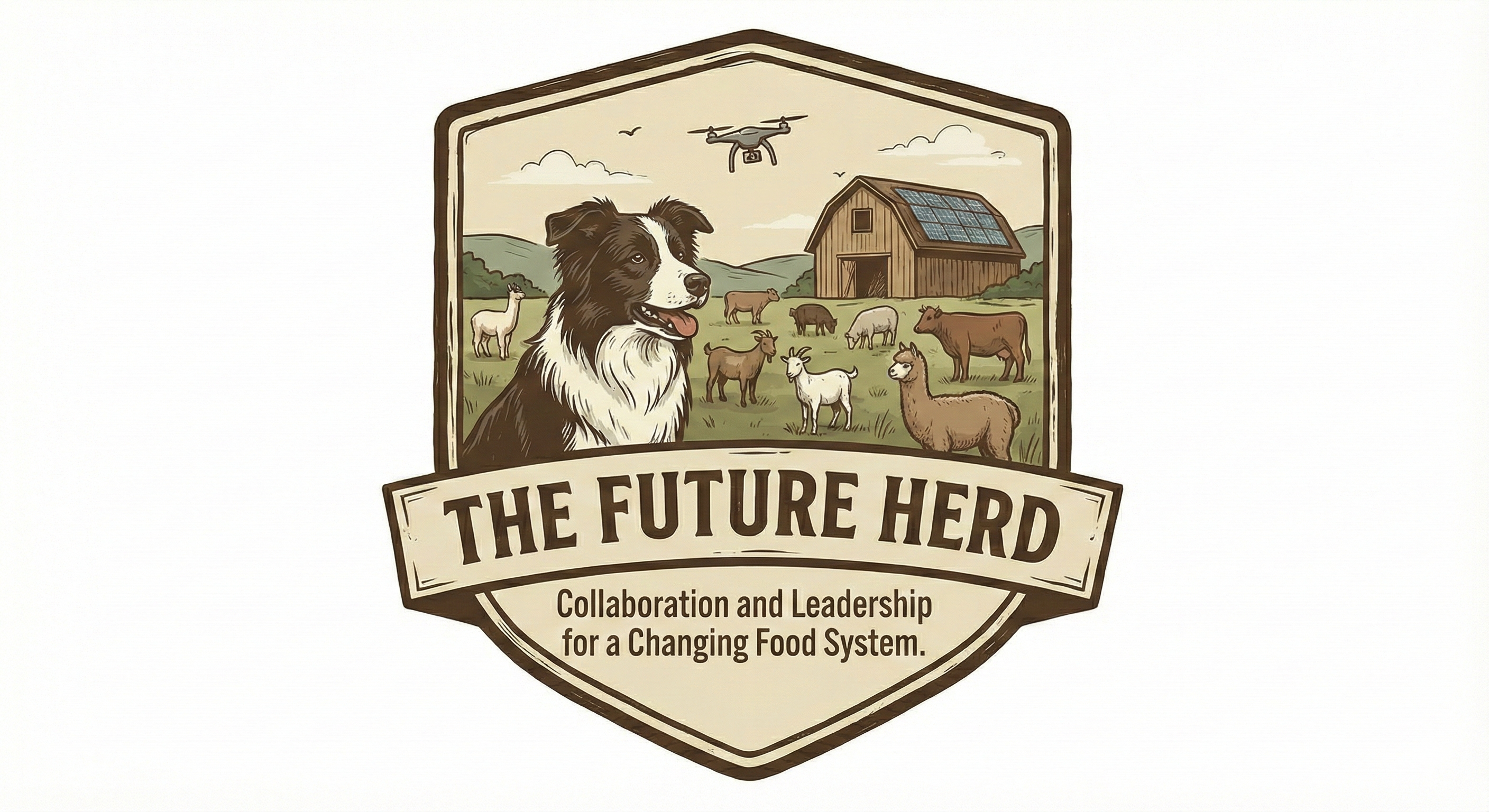
The Future Herd is guided by a collie mix.
A working animal shaped by adaptation rather than pedigree. Responsive rather than rigid. Capable of herding, yes—but also of improvising when the terrain changes.
A collie mix doesn’t enforce order from above. It reads the field. It negotiates movement. It works with the herd as it is, not as an idealized abstraction.
That distinction matters, because so much contemporary agri-food policy and technology is designed as if farmers, animals, and ecosystems were programmable components rather than living systems.
Season One keeps returning to a simple but uncomfortable question:
Who is food system transformation actually for?
For farmers—or for platforms? For animals—or for throughput metrics? For producers-or for waste? For communities—or for consolidation? For resilience—or for efficiency that collapses under stress?
Each episode is a conversation, but it’s also a reality check.
We talk with people working inside agriculture, food production, policy, research, and technology—not to celebrate disruption, but to examine its consequences.
We’re interested in what scales—and what breaks. What kinds of knowledge are being sidelined because they don’t fit institutional timelines or investor expectations.
The “future” in The Future Herd isn’t a prediction.
It’s a question about direction.
Are we building systems that allow independent actors—human and non-human—to adapt together? Or are we mistaking control for coordination, and optimization for care?
This podcast is for everyone. For eaters who want to know where their food comes from. For farmers who have leadership and wisdom to offer. It’s for policymakers who want fewer abstractions. For technologists willing to accept real constraints. And for anyone who senses that the future of food is being decided faster than it’s being understood.
We don’t promise answers.
We promise attention. Grounded conversations. And a refusal to treat food as just another sector to be managed from a distance.
This is Season One of The Future Herd.
Let’s begin where the future already is— in the movement of many independent lives, trying—together—to keep each other alive.
You’ve been listening to The Future Herd.
Many independent actors, adapting together.