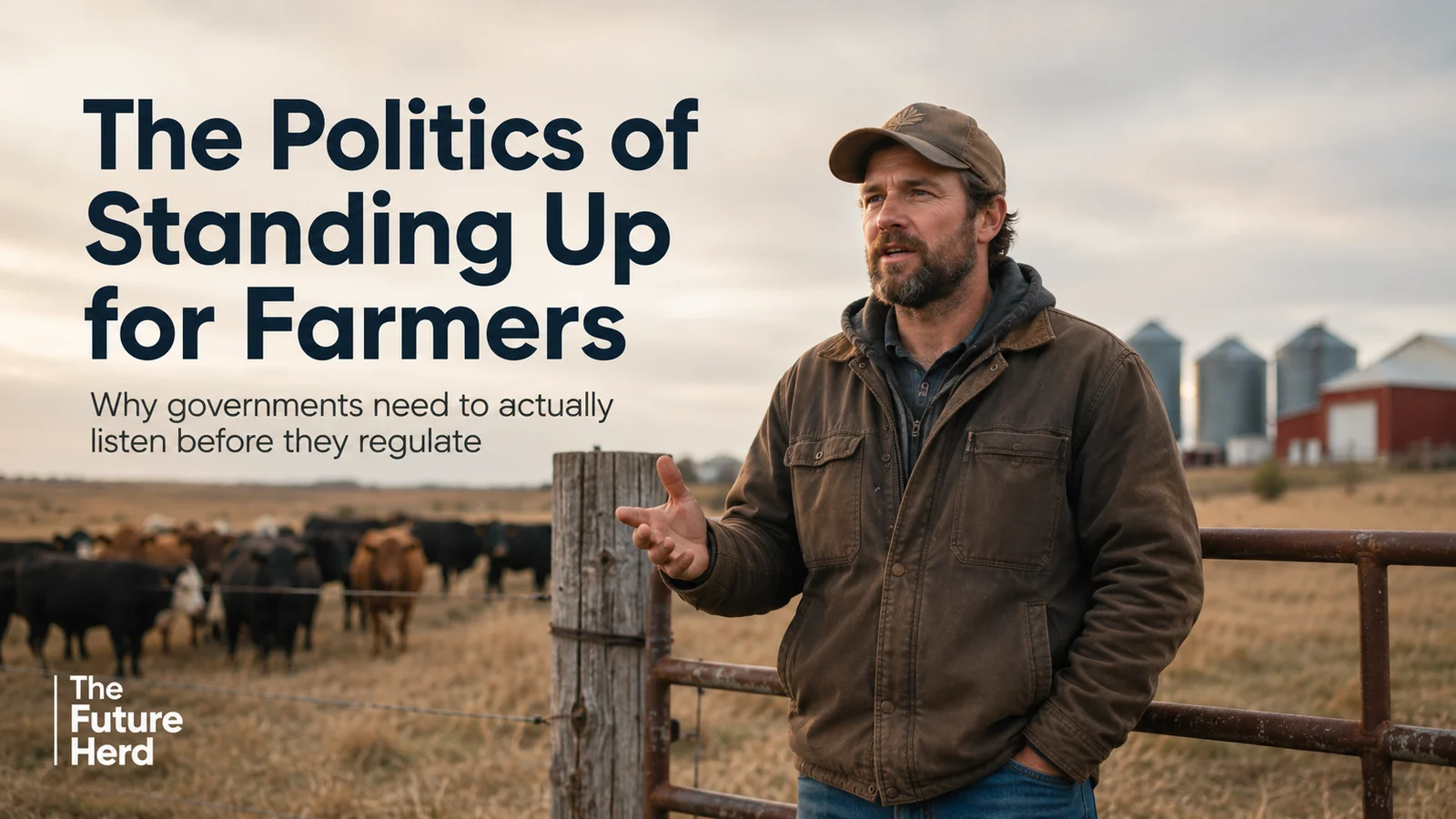
28: The Politics of Standing Up for Farmers with John Barlow
Episode 28 · May 29, 2026
John Barlow, Member of Parliament for Foothills, Alberta and shadow minister for agriculture, makes a direct case that Canadian governments have confused the performance of consultation with the practice of actually listening to farmers. Drawing on years of first-hand visits to farms and ranches across the country, Barlow argues that the disconnect between what Ottawa decides and what producers experience at the farm gate is not incidental — it reflects a deeper failure of political values, not just policy process. This episode explores what it would take to close that gap, and why Canada keeps reaching for an agricultural gold medal while stumbling at the start.
Overview
John Barlow, MP for Foothills, Alberta and the Conservative shadow minister for agriculture, joins Jesse Hirsh for a frank and wide-ranging conversation about why Canadian agriculture keeps falling short of its potential — not for lack of talent or land or ambition, but because the political and regulatory systems that govern the sector too often operate at a remove from the people most directly affected by their decisions. The central question this episode wrestles with is not whether governments say they support farmers, but whether they actually listen to them before acting — and Barlow's answer, drawn from years in the role, is that the gap between those two things is larger and more consequential than most Canadians appreciate.
Barlow uses the federal government's decision to close seven agricultural research stations and experimental farms as a case study in misplaced priorities. He notes that the closures will save roughly $200 million over a decade against a $75 billion deficit — a number he describes as findable many times over in other parts of the budget. His point is not primarily fiscal. It is that when a Prime Minister speaks on the global stage about food sovereignty, and then one of his government's first concrete agricultural decisions is to shutter the foundational research infrastructure that underpins it, the message sent to the sector is unmistakable: agriculture is not a genuine priority. For Barlow, decisions like this are not about budgeting. They are about values.
The conversation turns to a specific and instructive example of what happens when Ottawa moves without adequate ground-level consultation. The CFIA's proposed traceability rules for ranchers — raised by Barlow's office as a concern as early as 2023 — landed with force when they were formally released, with ranchers in his riding and across Western Canada responding with what he describes as alarm and disbelief. Crucially, there was a clear disconnect between what national commodity organizations like the Canadian Cattle Association had understood to be the scope of concern, and what individual ranchers were actually experiencing. Barlow's role in helping to surface and mediate that gap — connecting grassroots producers to national lobby groups in a way that eventually shifted the CCA's formal position — illustrates both the fragility of top-down consultation and the value of an elected representative who does the legwork of staying genuinely connected to the people they represent.
One of the more pointed threads in this episode is Barlow's frustration with how the media covers — and repeatedly fails to cover — agriculture with any sustained seriousness. He recounts a recurring pattern: journalists from major outlets reach out, ask for a primer on the sector, and then disappear. He saw a real opening during COVID, when empty grocery shelves briefly created public curiosity about where food actually comes from and how it reaches them. That moment, he argues, was largely squandered. He sees a comparable window now, with food affordability and trade pressures sharpening public attention, and his concern is that the sector will again fail to seize it. His travels to potato farms, cranberry bogs, and celery fields across the country have also reinforced a point he returns to repeatedly: farmers, regardless of scale or commodity, have been practising what is now branded as sustainable or regenerative agriculture for generations — not because it is trendy, but because neglecting soil, water, and livestock means losing your livelihood.
Listeners will come away from this episode with a sharper sense of the distance between political language and agricultural reality in Canada — and with a clearer picture of what it actually looks like when an elected official commits to closing that distance. Barlow does not traffic in abstractions. His argument is concrete: get out to the farm, sit in the cab, talk to the rancher, and then go back to Ottawa and make better decisions. The future he envisions for Canadian agriculture is not complicated in its outline — it requires removing the hurdles that keep a sector of enormous potential from reaching it. What makes this conversation valuable is the specificity with which he names those hurdles, and the honesty with which he describes how hard it is to move them.
Key themes
- performing consultation versus genuinely listening to producers
- closure of federal research stations as a signal of political values
- the traceability rules disconnect between national commodity groups and ranchers on the ground
- COVID and trade crises as missed opportunities to educate Canadians about farming
- regenerative agriculture as standard farm practice, not a new policy concept
- media neglect of agriculture and the revolving door of unfinished coverage