Agroecology, Indigenous Knowledge, and the Limits of Consumer-Focused Food Literacy
When food literacy stops at the grocery aisle, it mistakes the symptom for the system.
Published May 22, 2026
There is a familiar gesture in food education: the pivot to individual choice. Eat local. Read the label. Know your farmer. The gesture is not malicious — it draws real connections between personal behaviour and systemic outcomes — but it carries a quietly limiting assumption, that understanding food means understanding what to consume. Charles Levkoe, a food systems researcher and former agroecological farmer, challenges this directly. When people ask him what they should eat, his answer is disarming: he doesn't care. What they eat is their business, shaped by culture, body, and circumstance. What interests him is everything around that choice — the policies, relationships, histories, and power structures that make certain choices possible and others nearly invisible. That distinction is not a rhetorical provocation. It marks the boundary between food literacy as consumer guidance and food literacy as systemic understanding, and it is a boundary the dominant culture of food communication rarely crosses.
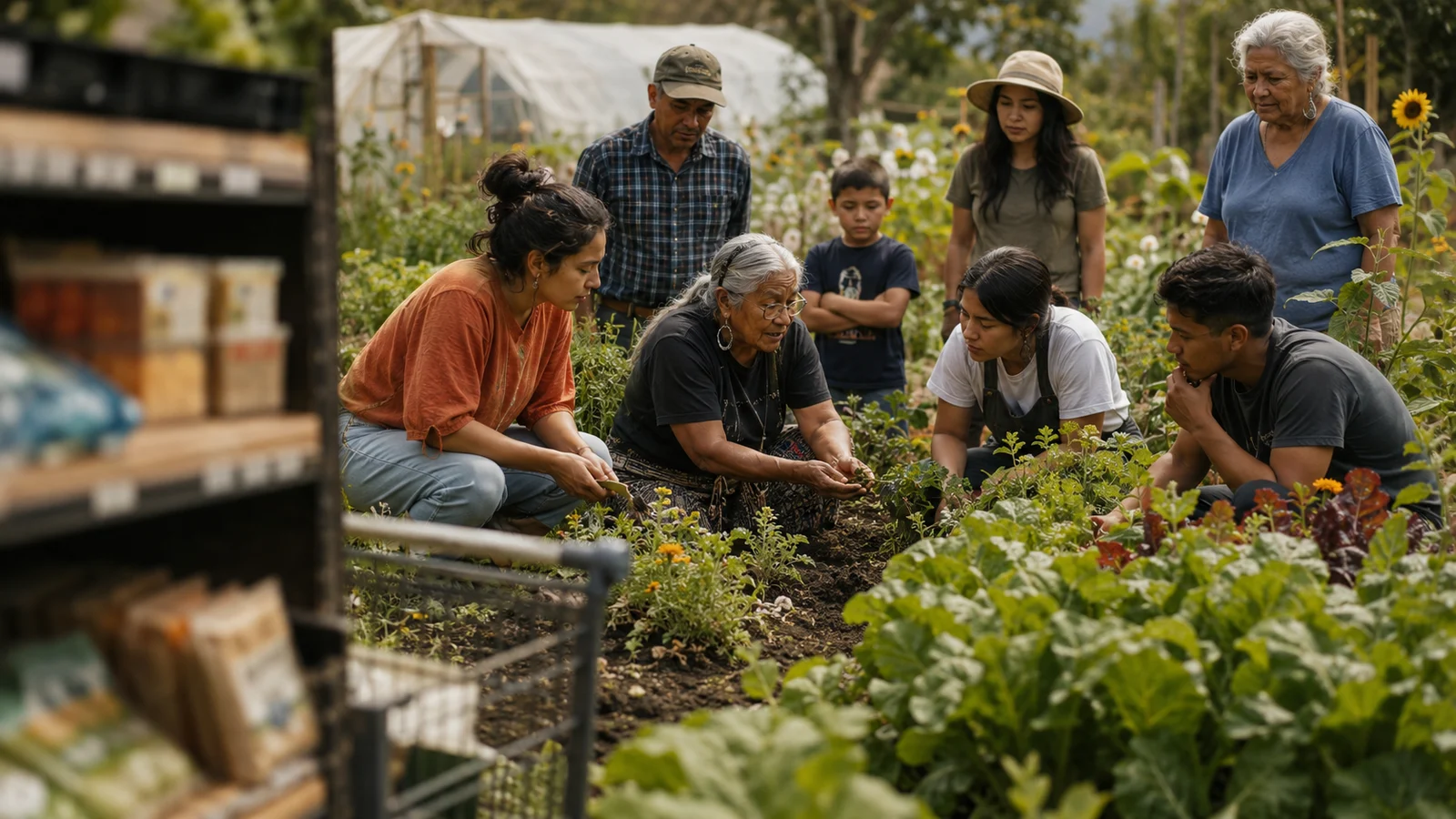
The concept Levkoe reaches for when mapping this fuller terrain is agroecology — a word that, as he notes, tends to be missing from mainstream food conversations. It is easy to understand why. Agroecology resists the kind of clean, scalable messaging that food marketing and even food advocacy tend to favour. It is not a certification or a product category. It developed not primarily in university laboratories but in the accumulated practise of peasant and farming communities, refined through international gatherings like the Via Campesina forums where growers and harvesters have collectively theorised both what just food systems look like and how to build them. Levkoe describes agroecology as having three parallel pillars: the science and research dimension, which takes soil science, climatology, and ecological knowledge seriously; the experiential knowledge of farmers and harvesters, which is treated as equally valid rather than subordinate to credentialled expertise; and the movement and governance dimension, which recognises that transformed practise without transformed policy simply reproduces the same structural barriers at a different scale. What makes this framework analytically useful is precisely what makes it difficult to commodify — it refuses to let any one of these pillars stand alone.
This refusal to isolate is, for Levkoe, the core intellectual and practical commitment of food systems thinking. He returns to it repeatedly: any time a problem is extracted from its context and addressed in isolation, the intervention tends to generate new complications while leaving the original structural conditions intact. The history of organic certification illustrates the dynamic with particular clarity. Organic farming began as a social movement organised around values — relationships to land, to community, to ecological integrity — and was gradually converted, especially in the United States with the passage of national organic standards, into a technical compliance framework: a list of what cannot be used, what must be documented, what a certifier must verify. The values did not disappear, but they became optional context around a set of regulatory requirements. Standardisation solved a real problem — it prevented fraudulent claims and gave consumers a basis for trust — but it did so by flattening the practise into something measurable, leaving behind precisely the relational and ethical dimensions that gave the movement its original coherence. Agroecology, in Levkoe's framing, is partly a response to that flattening: an insistence that how one relates to land, animals, water, and community matters as much as the specific inputs one avoids.
Nowhere is this argument more pointed than in its implications for indigenous knowledge. Levkoe is careful about his positionality here — he is not indigenous, he speaks from his own relationships and decade of experience in Northern Ontario, and he is clear that indigenous communities must speak for themselves. But he is also direct that the food system's treatment of traditional ecological knowledge is not simply an oversight; it reflects a set of structural choices about whose knowledge counts as knowledge. The experiential pillar of agroecology is, in practice, a challenge to a hierarchy that routinely elevates peer-reviewed science while treating the knowledge accumulated over generations of land-based relationship as anecdote, folklore, or at best a culturally interesting supplement to real expertise. This hierarchy did not emerge from neutral epistemological reasoning. It has a colonial history, bound up with the dispossession of land and the disruption of the food systems that sustained indigenous peoples long before European settlement reorganised the continent's agricultural relationships. To take indigenous knowledge seriously in the context of food systems is therefore not simply to add a new source of data to the pile. It is to contend with the question of why that knowledge was marginalised in the first place, and what structures continue to marginalise it.
This matters for the concrete, present-tense challenges of Canadian agriculture, not only for historical reckoning. Levkoe raises the demographic reality of an ageing farming population — a sector in which the average farmer is well into their fifties, with succession uncertain across huge portions of productive land — alongside the comparatively young demographics of many First Nations communities, particularly in Northern Ontario and across the country. He is explicit that these are not automatically connectable phenomena, and that the connections that do exist must be made carefully, on terms set by indigenous communities themselves rather than as a solution imported from outside. But the juxtaposition is worth sitting with. A food system genuinely oriented toward the experiential knowledge pillar of agroecology would not treat indigenous agricultural and harvesting knowledge as a resource to be extracted in a moment of sectoral crisis. It would have been building the policy and governance environments — the third pillar — that support indigenous food sovereignty continuously, as a matter of structural commitment rather than opportunistic response.
That is precisely where consumer-focused food literacy reaches its limit. Individual awareness, however sophisticated, operates downstream of the decisions that shape what land is available, what knowledge is fundable, what practises are supported by agricultural policy, and whose relationships to territory are legally and politically recognised. Levkoe's argument is not that consumers are powerless or that personal choices are meaningless. It is that a food literacy that stops at those choices — that asks what you should eat but not how the system was built, for whom, and at whose expense — cannot generate the understanding needed to change the structures that most determine food system outcomes. Agroecology, with its three interlocking pillars and its roots in the practise and theory of food sovereignty movements, offers a different kind of literacy: one that reads the food system as a living expression of political choices, ecological relationships, and inherited histories, all of which can, with sufficient imagination and collective will, be made differently.
Related Episode
Themes
- Agroecology as Political Practice, Not Technical Checklist
- The Isolation Problem in Food Systems Thinking
- Indigenous Knowledge as Structural Critique
- Food Sovereignty and the Three Pillars of Agroecology
- Consumer Choice as a Deflection from Policy Failure