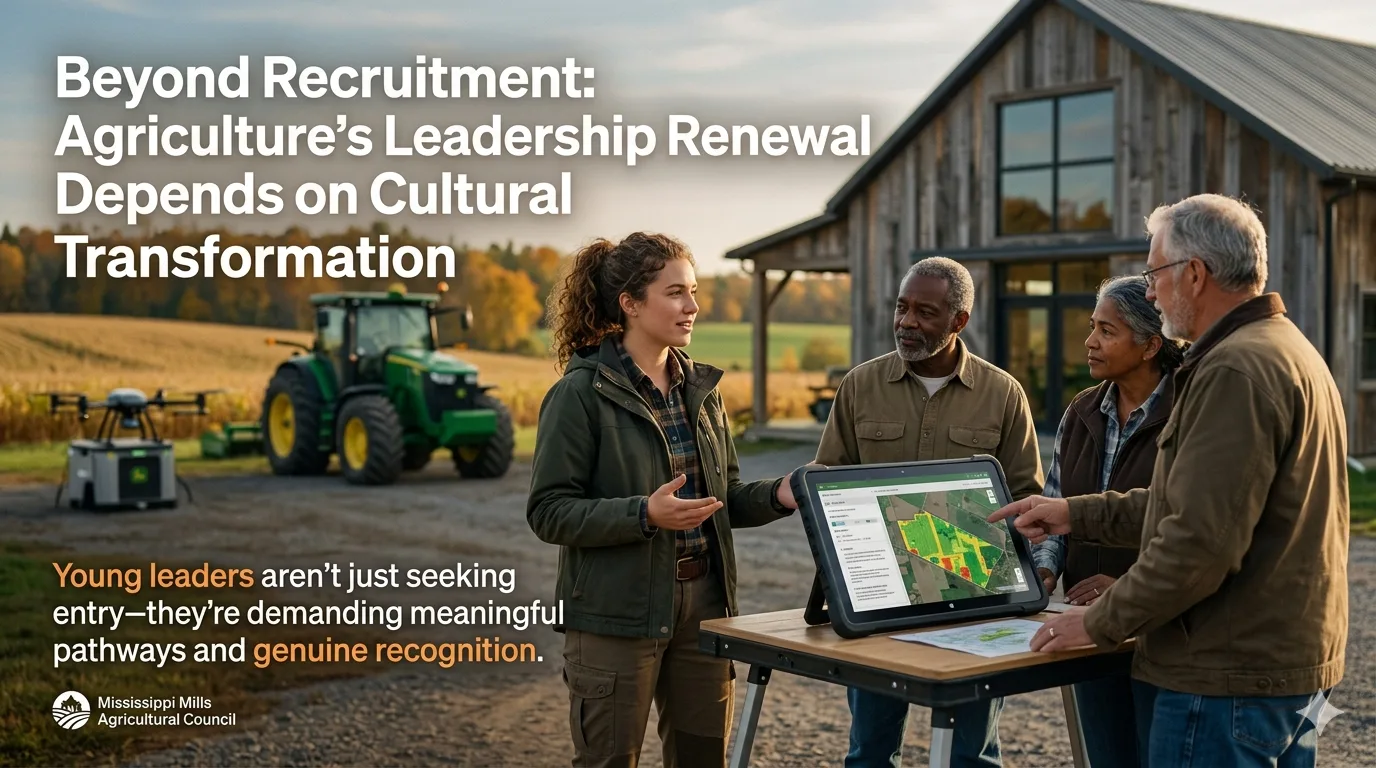
Beyond Recruitment: Agriculture's Leadership Renewal Depends on Cultural Transformation
Young leaders aren't just seeking entry—they're demanding meaningful pathways and genuine recognition.
Published April 14, 2026
The agricultural sector has long told itself a convenient story: that opportunities are universally available to those willing to work hard, and that the next generation will simply step up when called. But this narrative obscures a more complex reality—one where participation is uneven, exposure is selective, and the ability to imagine oneself in agriculture depends on specific conditions that many never encounter.
The true challenge facing agriculture isn't merely recruiting new talent, but fundamentally reimagining how young people are integrated, recognized, and empowered within the sector. This requires moving beyond transactional approaches to leadership development and towards a more holistic, culturally transformative model.
What makes this cultural shift possible are what might seem like small interventions: creating spaces where young people are taken seriously before they feel entirely ready, offering early responsibilities that signal genuine trust, and recognizing that leadership development is fundamentally about creating psychological pathways of belonging.
Organizations like the Junior Farmers Association of Ontario represent more than networking platforms—they are critical infrastructure for sectoral renewal. By providing young people opportunities to map organizational landscapes, understand intersectional challenges, and develop confidence through incremental leadership experiences, such groups become laboratories for cultural reimagination.
The most compelling leaders emerging in agriculture today aren't just technically proficient—they're adept at bridging traditionally separated domains. Take environmental science and agricultural practice: where older paradigms saw these as oppositional, emerging leaders recognize their profound interconnectedness. They understand that farmers are often the most committed environmental stewards, with economic incentives deeply aligned with long-term ecosystem health.
This approach demands a radical reframing. Young agricultural leaders aren't seeking to replace existing knowledge, but to expand and integrate it. They bring perspectives that see complexity not as a challenge to be managed, but as an opportunity for innovation. Their leadership is less about hierarchical control and more about creating collaborative networks that can rapidly adapt to changing ecological and economic conditions.
The critical question is no longer whether agriculture can attract young talent, but whether the sector is genuinely willing to be transformed by that talent. Are established leaders prepared to create meaningful platforms of genuine participation? Can they recognize that true leadership renewal requires cultural vulnerability—being willing to learn from those they might have previously dismissed?
Success will not be measured by recruitment numbers, but by the depth of cultural shifts. It means creating environments where young people don't just enter agriculture, but fundamentally reshape its imagination, practices, and sense of possibility. The future of agriculture depends not on maintaining existing structures, but on the courage to continuously reinvent them.
Related Episode
Themes
- Agricultural Leadership
- Generational Change
- Organizational Culture
- Youth Empowerment
- Sectoral Adaptation