Leadership in a Sector That No Longer Trusts Itself
Why emotional literacy and transparency are becoming core skills for the next generation of farm leaders
In a period of structural uncertainty, agricultural leadership is shifting from certainty and control toward curiosity, emotional intelligence, and trust-building across communities.
Published March 5, 2026
Agriculture is entering a period of structural uncertainty.
Global trade tensions reshape export markets with little warning. Public conversations about food production unfold in algorithm-driven environments where misinformation spreads easily. Political expectations of agriculture are shifting at the same time that generational change is reshaping leadership across the sector.
In this environment, the traditional model of agricultural leadership, projecting certainty, authority, and control, no longer works the way it once did.
Leadership today requires something different: transparency, curiosity, and a willingness to engage with people where they actually are.
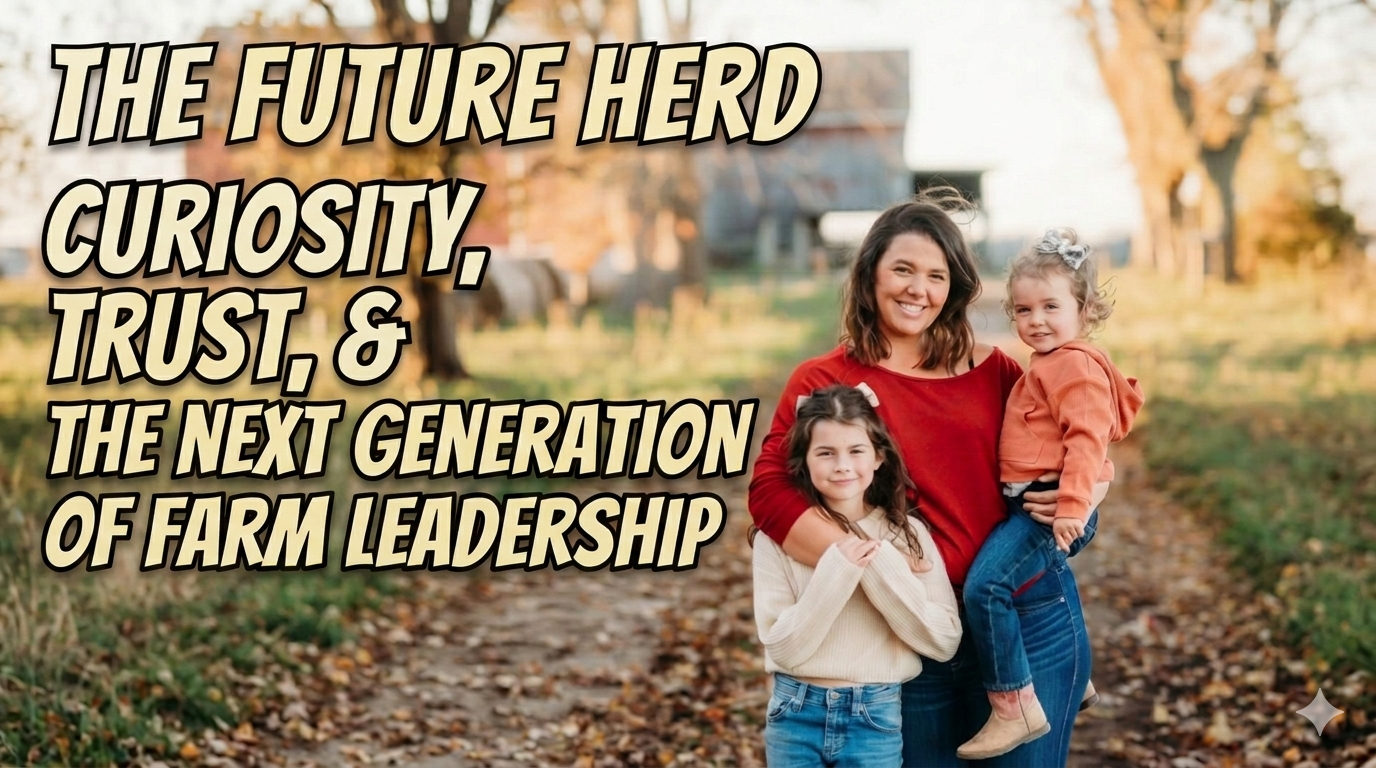
During a recent conversation on Future Herd, farm leader Steph Towers described a philosophy of leadership that reflects this shift. Her approach is less about commanding authority and more about building relationships, fostering learning, and connecting people across a sector that often struggles to see itself clearly.
Leadership Is Often Accidental
One of the striking insights from the conversation is how leadership in agriculture frequently emerges not through formal preparation but through necessity.
"For me it's about trying to make a difference," Towers explained. "It's seeing something that you're passionate about and wanting to be part of change, not just for yourself, but for those around you and for the industry as a whole."
She described many of the leadership roles she has taken on as emerging organically rather than through deliberate ambition.
"Throughout my life, I've taken on leadership positions not on purpose," she said, "but because someone needed to step up and do the work."
That pattern is familiar across agriculture. Many farm leaders emerge through volunteer roles, commodity organizations, community engagement, or advocacy work rather than through formal leadership pipelines.
For decades, that informal system functioned reasonably well. Today, however, the environment surrounding agriculture is far more complex.
A Sector Under Pressure
Farmers now operate in a landscape shaped by geopolitical tensions, climate volatility, rapidly evolving consumer expectations, and digital media ecosystems where debates about agriculture often unfold without context.
At the same time, internal divisions within the sector, between commodities, regions, and policy priorities, can make collective action difficult.
As Towers observed in the conversation, many of the sector's core policy priorities are widely shared.
"There's so many things that are fundamental that we all agree on," she said, pointing to issues like investment in processing capacity, reducing regulatory barriers, and strengthening rural infrastructure. "If we could align our voices and have that collaboration, we could move forward much faster."
The challenge is less about identifying priorities and more about building the leadership culture necessary to align around them.
Lifelong Learning as Leadership Infrastructure
For Towers, one of the core traits of effective leadership is a commitment to continual learning.
"I'm a big believer that you have to be learning something new every day," she said. "It's part of why we're here, and it's incredibly rewarding to keep learning and then put that knowledge into practice."
That mindset reflects a deeper shift taking place across agriculture.
Technical expertise, agronomy, livestock management, and finance, remains essential. But today's leaders must also navigate policy debates, media narratives, public perception, and global supply chains.
Leadership increasingly involves interpreting complexity for others.
The most effective leaders are not simply experts; they are translators, capable of helping different communities understand one another.
Emotion Is No Longer a Taboo
Another important theme that emerged during the conversation was the growing role of emotional intelligence in agricultural leadership.
For generations, farming culture has valued resilience and stoicism. Hardship was endured quietly. Emotional struggles were rarely discussed openly.
But that culture is beginning to change.
"I think there is movement towards accepting those emotional components as fundamental to connecting with people," Towers explained. "Emotional intelligence, being able to read someone, to understand what they're going through, that's becoming more recognized as part of leadership."
The growing visibility of mental health conversations within agriculture reflects this shift.
Events, organizations, and industry gatherings are increasingly creating space for producers to speak openly about stress, burnout, and isolation, issues that have long existed but were rarely acknowledged publicly.
This evolution is not simply about well-being. It is about leadership.
Understanding how people feel, and why, has become essential for navigating a sector facing constant pressure.
Curiosity as a Leadership Strategy
Another recurring theme in the conversation was curiosity.
Agriculture often finds itself responding defensively to criticism or misinformation about food production. But Towers suggested a different approach.
"The movable middle are people that are generally curious," she explained when discussing public perceptions of agriculture. "They want more information. They're looking to understand."
Curiosity creates space for dialogue rather than confrontation.
It allows leaders to engage audiences who may not share the same assumptions or baseline knowledge about food production. Instead of attempting to win arguments, curiosity opens the possibility of learning together.
In a media environment where social platforms increasingly shape public opinion, this approach may prove far more effective than traditional top-down messaging.
As Towers noted, these platforms have become central to how people build relationships and evaluate credibility.
"They've become people's social network," she said. "It has become their social fabric, and it is where trust is earned."
The Power of Connection
Ultimately, the leadership model that emerges from this conversation is deeply relational.
Towers repeatedly returned to the idea that agriculture must remain grounded in human connection, even as technology transforms production systems and communication channels.
"We're very good in agriculture at adopting innovation and adopting tech," she observed near the end of the conversation. "But technology is never going to replace that connectedness and those relationships."
This insight may be one of the most important lessons for the sector's future.
Technology will reshape agriculture in countless ways, from automation to data systems to biotechnology. But leadership will remain fundamentally human.
Trust, collaboration, and shared purpose cannot be automated.
Leadership Toward 2050
The future of agriculture will depend not only on technological innovation but also on the quality of its leadership culture.
The sector will need leaders capable of navigating complexity, building alignment across diverse stakeholders, and communicating clearly with the public.
That requires emotional intelligence. It requires curiosity. And it requires a commitment to learning.
Most of all, it requires leaders willing to step forward, not because they planned to become leaders, but because the work needs to be done.
As Steph Towers' reflections suggest, the future of agricultural leadership may look less like authority and more like stewardship: people helping other people understand a rapidly changing world.
And in a sector searching for alignment, that may be exactly the kind of leadership agriculture needs.
Related Episode
Themes
- leadership
- trust
- communication
- emotional-intelligence
- learning