Learning Is the Infrastructure
How knowledge transmission, not just production, determines agriculture's future
Published April 6, 2026
Agriculture appears, at first glance, to be a problem of production. Yields, inputs, efficiency, scale. These are the metrics we measure, the variables we optimize, the outcomes we debate. But beneath that surface sits a quieter system—one that determines whether any of those improvements actually take hold.
Agriculture runs on learning.
Not learning as formal education or technical training, but as something more distributed and embedded. People observe, imitate, adapt, and share. Knowledge moves through conversations, through shared work, through repeated practice. Over time, this creates a system that can reproduce itself—new entrants learn the craft, experienced practitioners adjust to change, and innovations find their way into use.
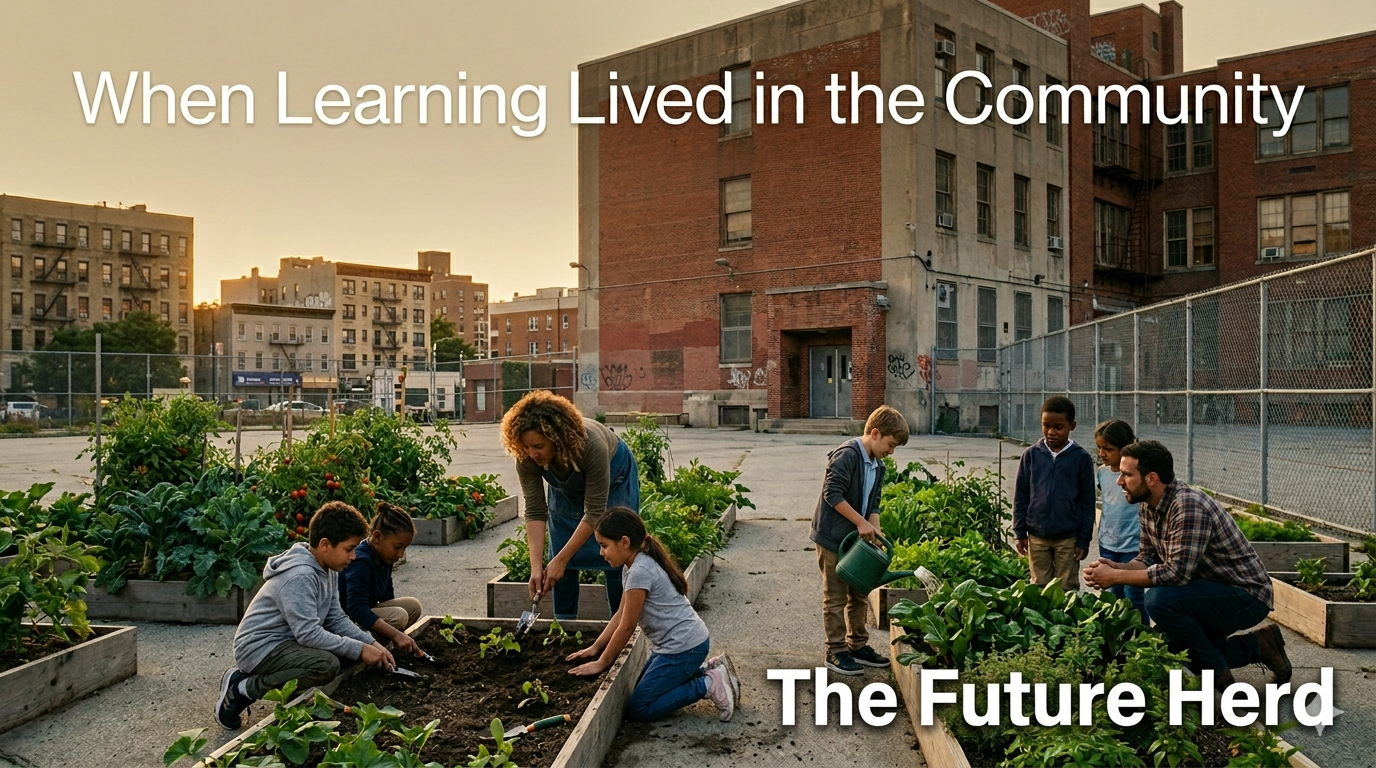
For much of the past century, this system had recognizable forms. Local clubs, extension programs, peer networks, and community institutions acted as conduits. They translated new ideas into practical knowledge. They created environments where people could learn by doing, alongside others, with a shared sense of purpose.
These were not peripheral features of agriculture. They were its infrastructure.
The work of Etienne Wenger helps make this visible. What he describes as "communities of practice" are not simply social groups, but learning systems—spaces where knowledge is created, refined, and transmitted through participation. Agriculture has long depended on such communities, even when they were not formally recognized as such.
Similarly, Elinor Ostrom demonstrated that shared systems—whether forests, fisheries, or irrigation networks—function when communities develop norms, relationships, and mechanisms for coordination. These are not imposed from above. They are cultivated over time. They depend on trust, proximity, and repeated interaction.
Seen this way, agriculture is not just a production system. It is a coordination system built on shared learning.
What has changed is not the need for this system, but its coherence.
Knowledge today is abundant. Research is published, tools are developed, innovations are announced. And yet, across the sector, there is a persistent sense that progress does not move as it should. Ideas stall. Practices diverge. Mistrust grows. New entrants struggle to find pathways into meaningful participation.
The issue is not a lack of knowledge. It is a failure of transmission.
The mechanisms that once carried knowledge—informal networks, local institutions, peer-based learning environments—have become more fragmented. Institutions remain, but often at a greater distance from lived experience. Communication becomes more abstract, less grounded in practice. At the same time, the complexity of the system increases, making it harder for individuals to interpret and apply what they encounter.
This creates a paradox. The system knows more than ever, but learns less effectively.
The consequences are subtle but significant. Innovation becomes uneven, adopted in some places and ignored in others. Policy struggles to land, not because it is poorly designed, but because it does not connect with how people actually make decisions. Leadership becomes harder to cultivate, as fewer spaces exist where individuals can grow into responsibility through participation.
Even trust—often treated as a cultural or psychological variable—reveals itself as infrastructural. Without trust, information is discounted, coordination breaks down, and the system fragments further. Trust, in this sense, is not an input. It is an outcome of sustained, shared learning.
The challenge, then, is not to return to a previous model, but to recognize what that model accomplished and to rebuild its functions under contemporary conditions.
This requires a shift in emphasis.
From delivering information to enabling learning. From scaling solutions to strengthening relationships. From centralized authority to distributed participation.
New forms are already emerging, though often in isolated pockets. Farmer-led knowledge exchanges that operate outside traditional institutions. Hybrid networks that combine in-person interaction with digital coordination. Apprenticeship models that prioritize immersion over instruction. Urban and rural hubs where learning is social again, not transactional.
There is also a role for new tools. Systems that map relationships, surface patterns, and connect fragmented knowledge can support this work. Not by replacing human interaction, but by making it more visible and more navigable. The goal is not to centralize intelligence, but to enhance the system's ability to learn collectively.
What becomes clear is that agriculture's future will not be secured by production gains alone. The capacity to produce depends on the capacity to learn, and that capacity depends on the structures—formal and informal—that allow knowledge to move.
Learning is not a byproduct of the system. It is the system.
To treat it otherwise is to misunderstand the problem. And to miss the opportunity.
Because rebuilding the infrastructure of learning is not only possible—it is already underway, wherever people choose to learn together, share what they know, and take responsibility for carrying that knowledge forward.
Related Episode
Themes
- Collaborative Learning
- Knowledge Infrastructure
- Systems Thinking
- Agricultural Innovation
- Community Practice