Making Innovation Legible to the Farm
Why innovation alone won't transform Canadian agriculture
Published March 20, 2026
Early in the conversation, Todd Ormann offers a deceptively simple reframing:
"It's not something arriving, it's something we're already inside."
The future of agriculture, in other words, isn't on the horizon. It's embedded in current practice — unevenly distributed, poorly integrated, and often misunderstood. That framing matters, because it shifts the problem. The issue is not whether innovation exists. It clearly does.
The issue is whether the system can recognize, absorb, and use it.
The Gap That Actually Matters
Across Canada's agri-food sector, innovation is rarely the bottleneck. Research institutions generate new tools, startups produce novel technologies, and policy frameworks frequently emphasize innovation as a priority.
And yet, as Ormann describes:
"Technologies exist, but getting them into real world use, trusted, tested, and practical is where the system often breaks down."
This is not a failure of invention. It is a failure of translation.
The sector lacks what might be called legibility — the ability to take something complex, experimental, or abstract and make it understandable, trustworthy, and usable within the realities of a working farm.
That gap is where most innovation dies.
The Missing Middle
Canada's agricultural system is structurally strong at the edges:
- Universities and research institutions generate knowledge
- Farmers operate with deep experiential expertise
- Governments fund both ends intermittently
What is weak is the connective tissue between them.
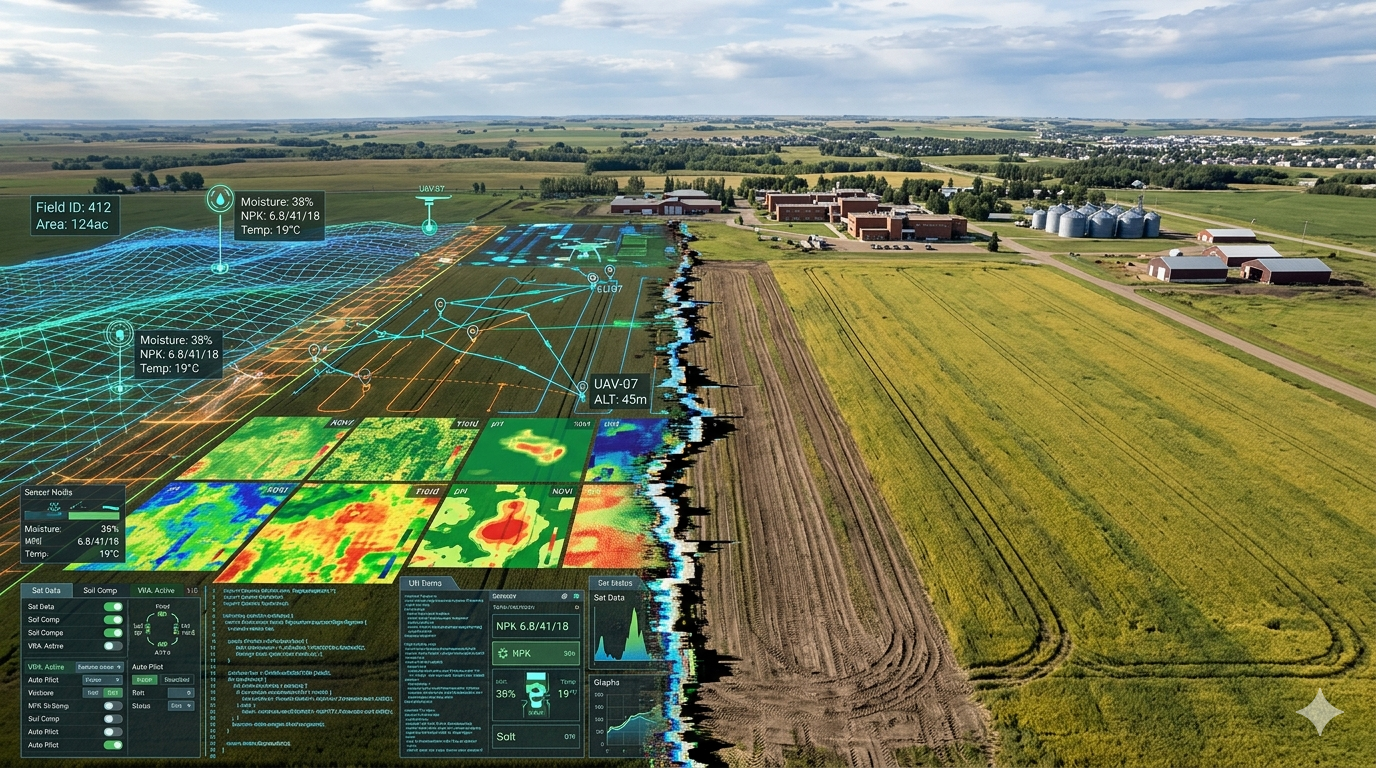
This "missing middle" is where technologies must be tested under real conditions, adapted to operational constraints, proven economically viable, and integrated into existing workflows.
Without this layer, innovation remains either too early (experimental) or too late (irrelevant).
Ormann's role at Olds College sits precisely in this space — between invention and adoption. Not as a site of discovery, but as a site of validation.
The Farm as a Site of Proof
One of the more subtle but important ideas in the conversation is that farms are not just sites of production. They are sites of verification.
A technology is not real — at least not in any meaningful sense — until it survives weather variability, cost pressures, labour constraints, and integration with existing systems.
This is why applied research environments matter. They do not ask whether something works in theory, but whether it works under pressure.
And this distinction is often underestimated in policy and innovation discourse.
Too much attention is placed on novelty. Not enough on durability.
Trust Is Built Through Use, Not Messaging
There is a persistent assumption that adoption is primarily a communication problem — that farmers resist innovation because they lack information or are culturally conservative.
The conversation complicates that narrative.
Trust is not built through persuasion. It is built through evidence in context.
Farmers adopt technologies when they can see how it performs in conditions similar to their own, how it integrates with their existing practices, and how it affects margins, not just yields.
In that sense, adoption is less about convincing and more about demonstrating.
Ormann's emphasis on validation reflects this: innovation must become legible through experience, not just explanation.
A Fragmented System That Cannot Coordinate Itself
What emerges most clearly is that Canada's agri-food system is not failing due to lack of intelligence or effort. It is failing due to fragmentation.
Different parts of the system are optimizing for different goals: researchers for discovery, startups for growth, governments for program delivery, farmers for survival.
There is no shared infrastructure that ensures alignment.
This leads to a situation where innovations are developed without clear pathways to adoption, producers are presented with tools that do not fit their realities, and institutions duplicate efforts rather than coordinate.
The result is not stagnation, but inefficiency at scale.
Institutions That Translate
Olds College represents a different model — one that treats translation as its primary function.
Not just generating knowledge. Not just teaching students. But making innovation usable.
This kind of institution does three things simultaneously: tests technologies in real conditions, builds trust through demonstration, and connects actors who otherwise operate in isolation.
In doing so, it performs a role that is largely missing elsewhere in the system.
If Canada is serious about agricultural innovation, it may need more institutions like this — not fewer.
The Work After the Breakthrough
The dominant narrative of innovation celebrates breakthroughs: the moment something new is discovered or invented.
But as this conversation makes clear, the breakthrough is the easy part.
The harder work comes after: refining, validating, integrating, scaling.
This is slow, unglamorous, and often underfunded.
It is also where transformation actually happens.
Making Innovation Legible
To say that innovation must become "legible to the farm" is to recognize that usefulness is not inherent. It is constructed.
A technology becomes real when it can be understood within a farmer's decision-making context, trusted through observed performance, integrated without excessive disruption, and justified economically.
Until then, it remains potential.
Canada does not lack innovation. It lacks the systems that make innovation usable.
And until that changes, the future of agriculture will remain unevenly distributed — not because it hasn't arrived, but because it hasn't been made legible.
Related Episode
Themes
- Innovation and adoption
- Applied research
- Institutional design
- Workforce development