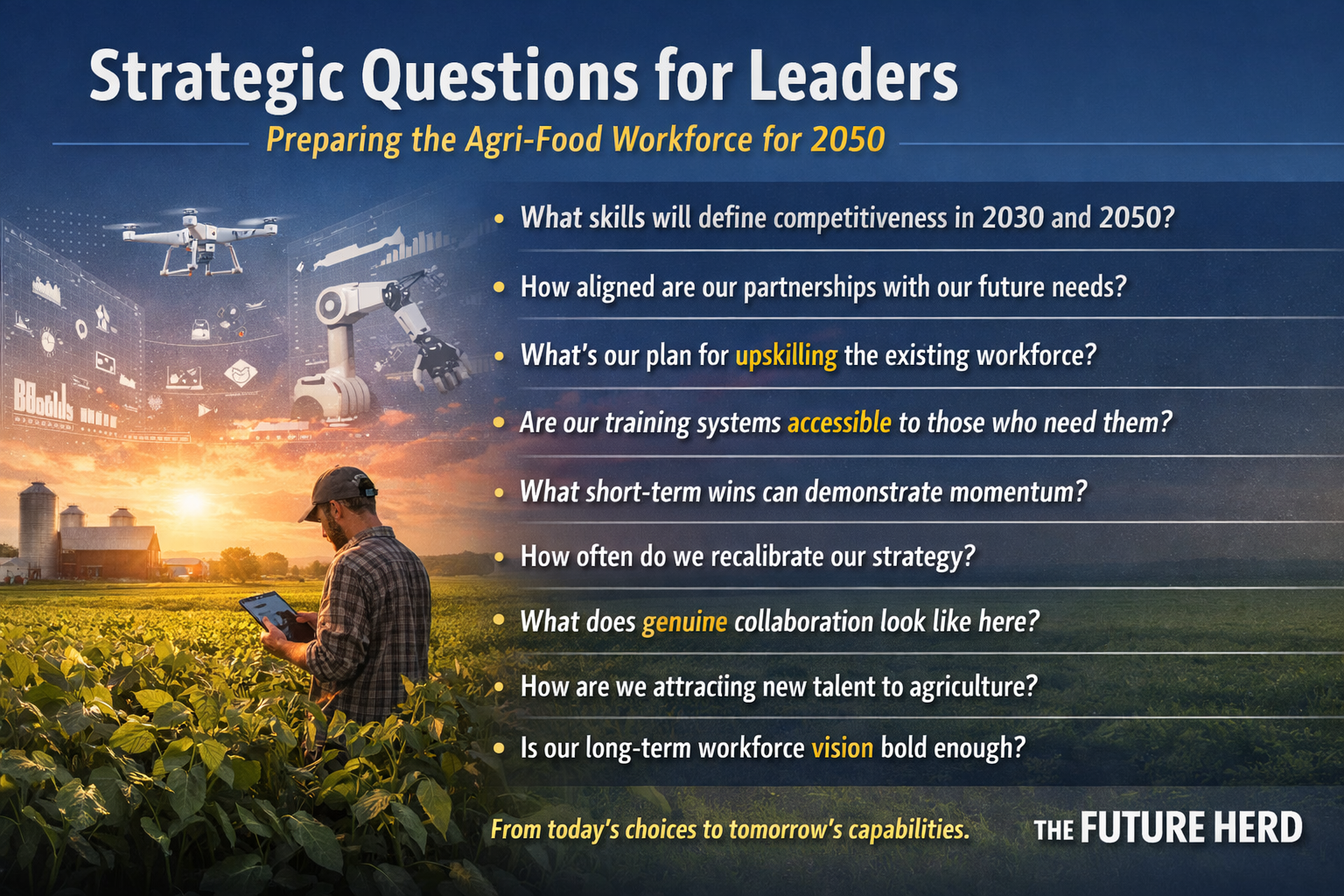
Strategic Questions for Leaders: Preparing the Agri-Food Workforce for 2050
A companion handout for leadership teams, boards, educators, and sector partners.
Published February 9, 2026
Overview
This knowledge entry is a practical leadership handout: a set of strategic questions designed to guide planning discussions about the agri-food workforce between now and 2050. It complements the episode conversation with Jennifer Wright (CAHRC) by translating big themes—skills, training, and collaboration—into prompts that support decisions, prioritization, and accountability.
It matters now because technology adoption is accelerating while workforce shortages and skills gaps persist. Without a deliberate plan for training, retention, and partnership-building, the sector risks treating innovation as a procurement problem rather than a capacity problem.
Core idea
The future of agri-food innovation depends less on the tools we buy and more on the skills ecosystem we build. Workforce development is not a side project; it is the enabling infrastructure for modernization, resilience, and growth.
Key points
- Workforce capacity is a primary constraint on technology adoption; innovation requires trained and supported people.
- Collaboration must function as infrastructure, aligning industry needs with education and training supply.
- Hybrid training models—micro-credentials, on-the-job learning, remote delivery, and emerging tools like VR—expand access and speed up capability-building.
- Future-focused initiatives need “what now” discipline: short-term deliverables, metrics, and iterative strategy review.
Implications
- Implication for policy / institutions: Incentivize coordinated training pathways, shared standards, and rapid credentialing aligned to real sector needs.
- Implication for producers / practitioners: Prioritize retention and upskilling; treat training time and tools as operational necessities, not optional extras.
- Implication for research / innovation: Design technology development alongside adoption capacity—skills, usability, and support models are part of the innovation.
Open questions
- What skills will define competitiveness in 2030 and 2050, and which gaps are already visible today?
- Are our partnerships aligned with future needs, and who is missing from the table?
- What is our upskilling and reskilling plan for the existing workforce, and how will we measure progress?
- Are training systems accessible where people live and work (on-farm, online, close to home), and what barriers remain?
- What short-term wins can we deliver in the next 6–12 months to prove momentum and build trust?
- How often do we recalibrate strategy to keep pace with rapid technological and economic change?
- What does genuine collaboration look like inside our organization—structures, decision-making, and shared accountability?
- How are we telling the story of innovation to attract new talent into the sector?
- Is our long-term workforce vision bold enough to match the scale of change we expect?
- What commitments are we prepared to make now—investment, partnerships, and timelines?
References
-
Related links:
Related Episode
Themes
- Workforce development
- Skills and training infrastructure
- Collaboration and coordination
- Technology adoption (AI, automation, robotics)
- Strategic planning and accountability