Sleep and Emotional Discipline Are the Productivity Infrastructure High-Performing Agricultural Leaders Depend On
When your work day runs from 7 AM to 11 PM, sleep isn't a luxury you earn — it's the non-negotiable input that makes everything else function.
Published May 19, 2026
The agricultural sector has long worn relentless work as a badge of honour. Seventy-hour weeks during seeding, decisions made under financial pressure and weather uncertainty, the compounding weight of running a business while managing a family operation — these are not abstractions for leaders in the sector. They are Tuesday. What gets talked about far less is what sustains a person through all of it. Not grit, exactly, and not willpower in any motivational-poster sense. Rather, the unglamorous infrastructure underneath high performance: sleep, emotional regulation, and the discipline to treat both as professional necessities rather than personal indulgences.
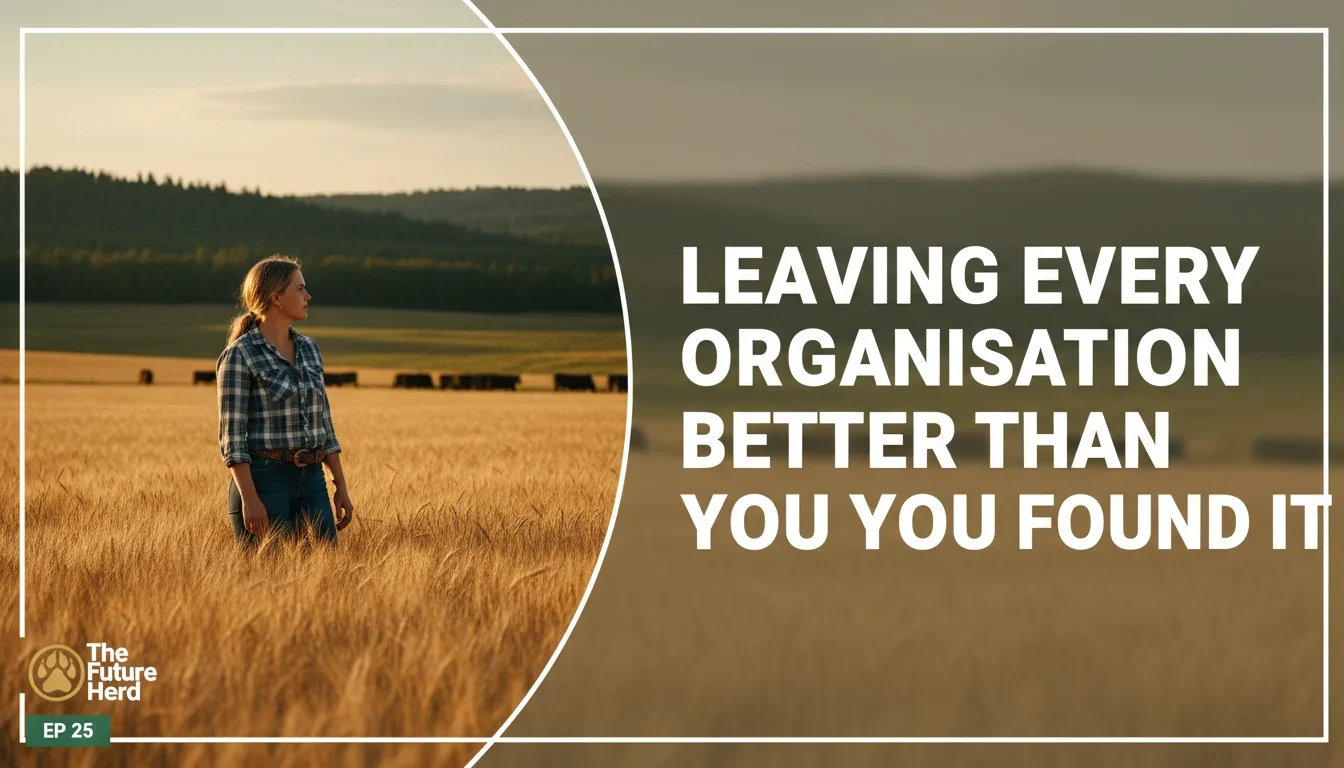
Kaitlyn, an entrepreneur and agricultural leader based in Saskatchewan who joined The Future Herd for episode 025, offered a window into how she manages this infrastructure in practice — and why the framing matters as much as the habit itself. Working across her own business, multiple board roles, and a family farm navigating succession, she described a schedule that routinely runs from early morning to near midnight. The honest tension she named is one many agricultural leaders will recognise: entrepreneurship promises schedule flexibility and delivers something closer to total availability. The hours don't shrink; they just redistribute. Against that backdrop, protecting sleep is not a passive outcome but an active choice — one that has to be defended repeatedly against the pull of unfinished work.
Sleep Is a Thinking Tool, Not a Recovery Reward
What stands out in Kaitlyn's approach is not simply that she sleeps seven to eight hours a night, but why she frames it the way she does. Sleep, for her, is not what happens after the real work is done. It is what makes the real work possible. She is explicit about this: she thinks better when she has her sleep. During university, while peers pulled all-nighters before exams, she made the deliberate calculation that arriving well-rested was worth more than a few extra hours of review. The brain she showed up with at full capacity was a better instrument than a depleted one crammed with last-minute information.
This is a meaningful distinction for agricultural leaders specifically, because the cognitive demands of the role are easy to underestimate from the outside. Farm succession planning requires navigating legal, financial, and deeply personal dynamics simultaneously. Board governance requires reading people, holding tension between competing interests, and making decisions under incomplete information. Managing employees across a growing business requires emotional precision as much as operational competence. None of these tasks are well served by a chronically tired mind. The irony of high-achieving, high-commitment leaders is that the very drive that pushes them to work longer hours can quietly erode the cognitive quality that made them effective in the first place. Kaitlyn's instinct — stop, sleep, return sharper — is a corrective to that drift.
She also acknowledged that this discipline is uneven in practice. Event season, back-to-back commitments, the social pressure of FOMO in a sector where relationship-building happens at gatherings — all of these push against the habit. Her solution is structural rather than aspirational: she protects weekends, avoids booking them solid, and uses them to recover what the week has taken. People around her have become an informal accountability system, nudging her when she's overcommitting. She admits she is still learning to say no. That admission is worth dwelling on, because it reframes the challenge. This is not about someone who has solved the problem; it is about someone who has built practices to manage a tension that never fully resolves.
Emotional Literacy as Professional Infrastructure
Sleep, however, is only part of the picture. Kaitlyn has invested equally in what she calls soft skills — conflict resolution, communication, people management — and she is candid that these are not supplementary to her work but central to it. She leads a team of seven, sits on multiple boards, and manages the complex interpersonal terrain of a family farm. In each context, the technical knowledge matters less than the capacity to navigate people: their different personalities, their different working styles, their different stakes in any given decision.
This is not a new observation in leadership literature, but it lands differently when it comes from someone working at the intersection of entrepreneurship, board governance, and family farming. Those three environments each generate their own emotional friction. A board is a room full of accomplished people with distinct mandates and limited time. A family farm is a room full of people who love each other and have years of accumulated history, expectation, and grievance sitting just beneath the surface of any business conversation. Kaitlyn noted that even on a difficult day — she is direct enough to say "people suck" and mean it — her response is not to push through or suppress the frustration but to physically step away, go for a walk, and return when she can think clearly again. That is not avoidance. That is emotional regulation as a professional skill.
Reframing the Conversation: Battery Levels and Permission to Talk
The most practically interesting contribution in Kaitlyn's thinking may be the "battery" framing she uses to talk about stress and mental health. Rather than asking colleagues or peers how their mental health is — a question that still carries stigma in agricultural contexts, as she acknowledged — she asks where they are on their battery. Are they at 75%? 50%? What do they need to charge back up?
This reframe works for several reasons. It depersonalises the question just enough to make it answerable. It makes the concept of capacity concrete and quantifiable in a way that resonates with people who are used to thinking in practical terms. And it opens a conversation about what someone needs — rest, space, connection, time off — without requiring them to identify as struggling. In a sector where mental health stigma remains a real barrier to honest self-assessment, that linguistic entry point matters. It gives people permission to report on their state without having to label it.
What emerges across all of this is a coherent philosophy, even if Kaitlyn would not call it that. Sleep is not the reward for finishing the to-do list; it is the input that makes the list manageable. Emotional skill is not a soft complement to hard business knowledge; it is the primary tool for anyone operating across multiple complex human systems simultaneously. And the language used to talk about wellbeing shapes whether people can access those conversations at all. Agricultural leaders are asked to carry an enormous amount — operationally, financially, relationally. The ones who sustain that load over time are not the ones who ignore its weight. They are the ones who have built honest, unglamorous systems to manage it.
Related Episode
Themes
- Sleep as Cognitive Capital
- Battery Framing as Mental Health Reentry Point
- Emotional Soft Skills Over Technical Knowledge
- The Hidden Cost of Entrepreneurial Hustle Culture
- Saying No as a Learned Leadership Competency