Universities and the Future of Agri-Food Leadership
A Brief Inspired by a Conversation with Rene Van Acker, President and Vice Chancellor, University of Guelph
Universities can help lead agri-food resilience by combining long-term research, public engagement, interdisciplinary collaboration, and student-driven innovation.
Published February 17, 2026
Overview
Agriculture faces a convergence of long-term pressures: climate volatility, technological disruption, demographic change, and rising public expectations for transparency and resilience. Universities hold a unique position within this landscape. Their research capacity, long-term perspective, and cultural orientation toward public service position them as critical partners in shaping the future of the agri-food system.
This brief outlines key insights from a discussion with Rene Van Acker on how universities, researchers, students, and practitioners can collaborate to build a more adaptive and forward-looking sector.
1. Collaboration as the Foundation of Foresight
Universities have the rare ability to think beyond immediate returns and short-term pressures. For sectors driven by urgent practical demands, like agriculture, this long-term perspective is indispensable.
Van Acker emphasizes that collaborative, real-world engagement is already embedded in the University of Guelph's culture, shaped by its agricultural and veterinary heritage. Faculty work closely with farmers, industry, NGOs, and communities, ensuring that research is grounded in practice.
Key insight: Collaboration is not optional. It is the enabling condition for long-term foresight. Without partnerships that cross institutions and sectors, the capacity to anticipate and prepare for future challenges remains limited.
2. Extension and Public Engagement Remain Essential
Extension, now often called knowledge mobilization, is still central to the university's mission. While not supported by dedicated funding models in Canada, faculty continue to pursue it because it strengthens relationships, builds shared understanding, and helps translate research into practice.
Advances in media and digital communication are expanding what extension can be. Podcasts, social platforms, data tools, and remote learning environments are lowering barriers and creating new spaces for engagement.
Key insight: Extension is a cultural asset, not merely a program. Sustaining and modernizing it requires institutional commitment and broader public investment in connectivity, particularly rural broadband.
3. Interdisciplinarity and Entrepreneurialism as Engines of Innovation
Innovation in agriculture increasingly requires the integration of technologies and perspectives that originate outside traditional agri-food domains. Entrepreneurialism invites new disciplines, engineering, computer science, design, and data analytics, into the sector and accelerates cross-pollination.
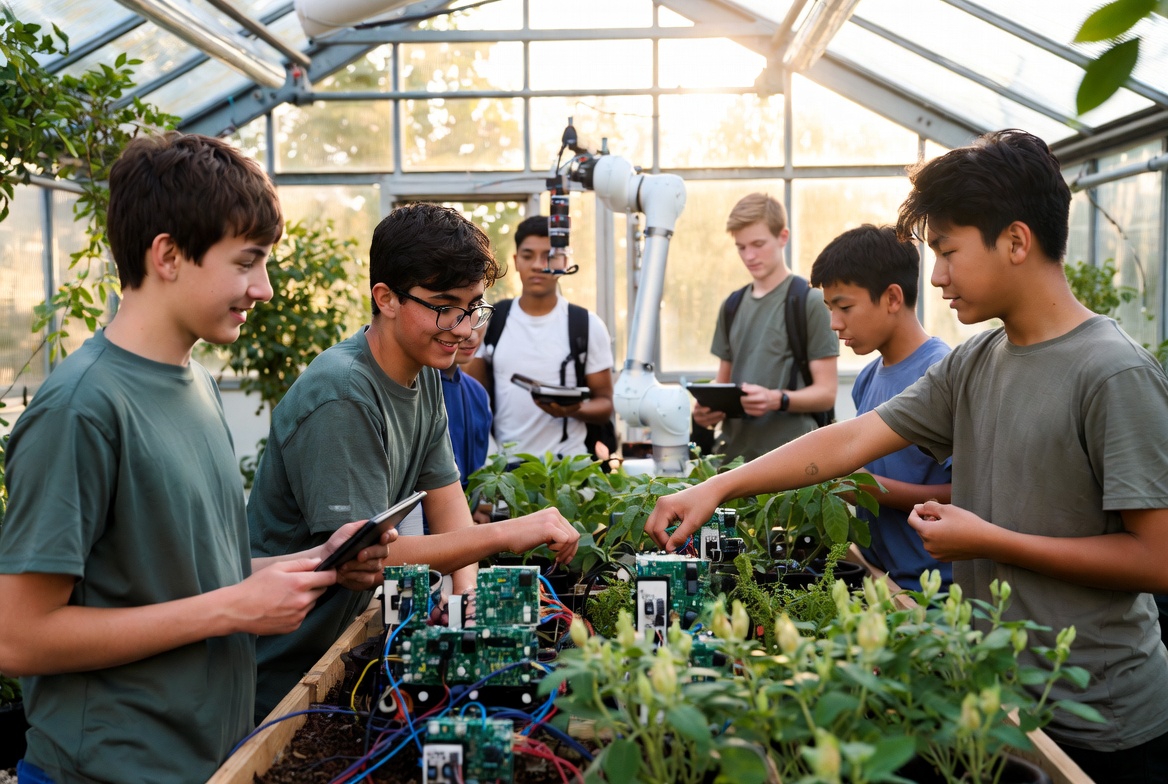
Students, in particular, are driving this shift. Their openness to new tools and willingness to challenge assumptions make them powerful agents of change.
Key insight: Interdisciplinarity is no longer an enhancement. It is now a prerequisite for addressing complex agricultural challenges.
4. Leadership Is the Ability to Create Open Space for New Futures
Van Acker stresses that leadership within universities and institutions must involve more than administrative stewardship. It requires actively making room for futures that are not merely extensions of the past.
To do this, leaders must be willing to be challenged, listen to new ideas, and translate inspiration into concrete institutional action, such as supporting early-stage entrepreneurial ecosystems or expanding access for students.
Key insight: Leadership is future-making: the deliberate creation of the conditions in which new ideas, people, and collaborations can emerge.
5. Students as Drivers of Cultural and Technological Transformation
Despite narratives of distraction or disengagement, students remain deeply curious, technologically fluent, and motivated by pressing issues, especially climate change. Their energy, impatience, and willingness to imagine alternative futures give universities a unique resource.
Opening more seats, supporting student-led ventures, and integrating students into real-world research allow that momentum to shape the sector.
Key insight: The next generation is not a burden to engage but a strategic advantage to cultivate.
6. Climate Volatility as the Central Foresight Challenge
Although climate change did not feature prominently at the Agri-Food 2050 event, Van Acker stresses that farmers themselves are acutely aware of its impacts. They observe firsthand the increasing amplitude of weather extremes, heat, drought, floods, and unpredictability.
For agriculture, volatility, not simply gradual warming, is the core threat. It undermines planning horizons, disrupts production cycles, and increases systemic risk.
Key insight: Foresight is incomplete if it does not account for the climate's increasing unpredictability. Sector-wide planning must normalize climate literacy and long-term scenario thinking.
7. The Need for Long-Term Thinking in a Short-Term Political Culture
Modern politics and media emphasize the immediate, the sensational, and the incremental. Agriculture cannot operate on these timelines. The cultivation of climate resilience, soil health, new production systems, and new research and training infrastructure requires decades.
Institutions like the Adaptation Council, and leaders within universities, can anchor long-term conversations that resist short-term pressures.
Key insight: Foresight is a cultural practice. It must be reinforced through institutions, partnerships, and public dialogue that prioritize decades over minutes.
Conclusion
Universities have a critical role to play in shaping Canada's agri-food future. Through collaboration, extension, interdisciplinarity, leadership, and the empowerment of new generations, they can help build a sector capable of navigating volatility while advancing resilience, innovation, and public value.
The agri-food system needs not just new technologies, but new ways of thinking, and universities, at their best, are uniquely equipped to nurture both.
Related Episode
Themes
- University leadership
- Collaboration and foresight
- Extension and knowledge mobilization
- Interdisciplinary innovation
- Climate volatility and resilience
- Long-term institutional planning