Episode 16: Manitoba's Agricultural Advocacy in a Time of Constant Shift
Episode 16 · April 17, 2026
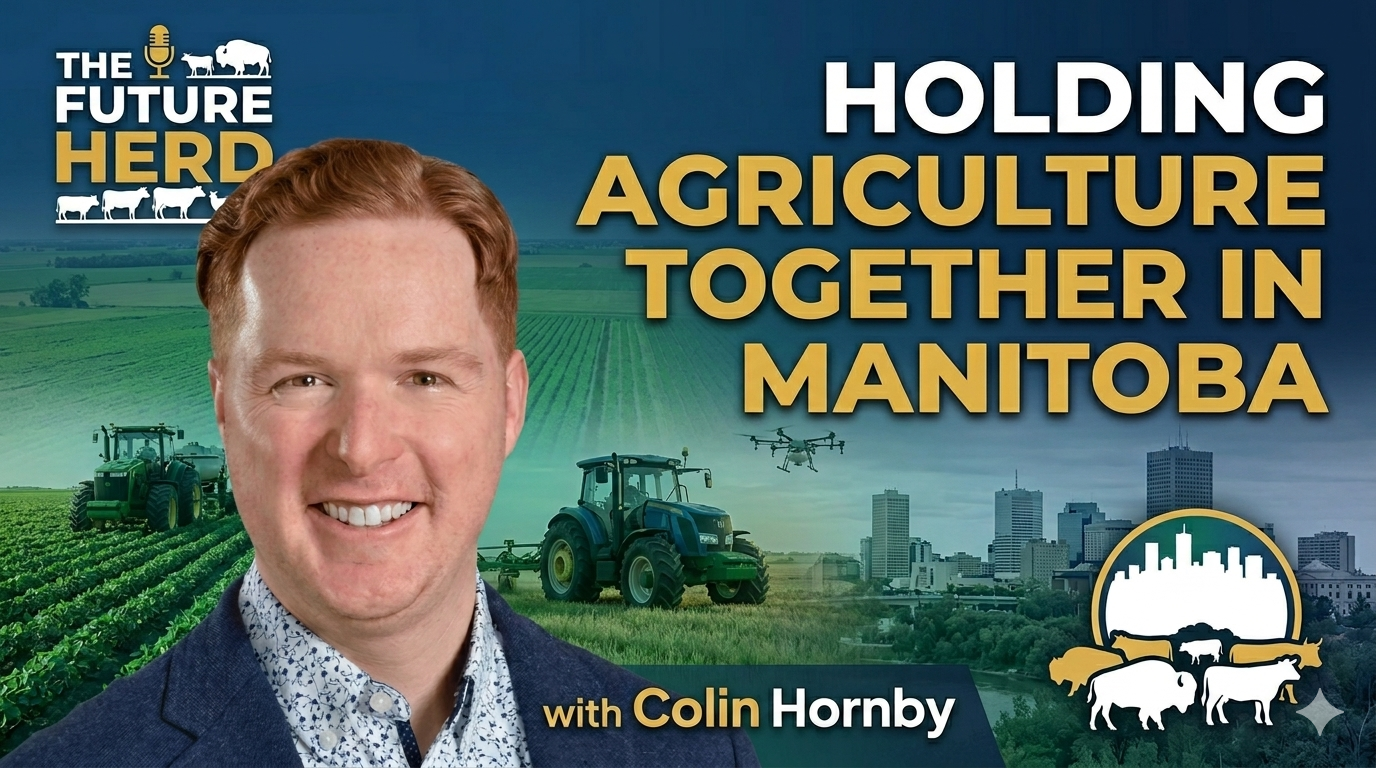
Colin Hornby, Executive Director of Keystone Agricultural Producers, joins The Future Herd to explore the complex landscape of agricultural representation in Manitoba. Through his lens, the episode examines how policy, risk, and advocacy intersect in a province that sits at the center of Canada's agricultural innovation.
Overview
Colin Hornby embodies a new generation of agricultural leadership—one that understands policy not as a static document, but as a living conversation. As Executive Director of Keystone Agricultural Producers (KAP), he represents a sector defined by constant adaptation, where farmers must simultaneously manage immediate challenges and long-term strategic vision.
The episode explores Manitoba's unique agricultural ecosystem, a landscape where innovation, trade, and policy converge with remarkable complexity. Hornby brings insights from his extensive background in political and legislative work, offering a nuanced perspective on how agricultural advocacy must operate in an era of unprecedented volatility. His approach emphasizes collaboration across different agricultural subsectors and value chain participants, recognizing that sustainable progress requires finding common ground.
Listeners will gain a deeper understanding of the mechanics of agricultural representation, particularly how organizations like KAP bridge gaps between individual farmer experiences and broader policy frameworks. The conversation goes beyond typical discussions of agricultural challenges, instead focusing on the human dynamics of leadership—how representing diverse interests requires listening, negotiation, and a commitment to collective progress rather than narrow sectoral gains.
Ultimately, this episode reveals agriculture as a domain of continuous learning and adaptation. Through Hornby's lens, the sector emerges not as a traditional industry, but as a dynamic system constantly recalibrating to economic, environmental, and technological shifts. His perspective offers hope: that with the right leadership, agriculture can be a powerful site of innovation and resilience.
Key themes
- navigating diverse agricultural interests
- policy translation from federal to provincial
- risk management in agriculture
- collaborative leadership
- future of farming