55: Urban Farms Are Training Grounds For Rural Succession
Episode 55 · November 23, 2026
Richard Scott Bloomfield argues that urban farms are not a novelty or a hobby garden but a practical on-ramp into farming for a generation almost never told that agriculture is a career path. Drawing on his work with Urban Roots in London, Ontario, he makes the case that accessible city-based growing could help address Canada's looming farm succession and labour crisis — while warning that hype-driven ventures like vertical plant factories drain the capital and attention that this quieter work needs.
Overview
Richard Scott Bloomfield joins Jesse Hirsh to explore a provocative claim: urban farms may be the best training ground Canada has for rebuilding its farming population. Richie came to urban agriculture through undergraduate study of globalization, was pulled into co-founding Urban Roots in London, Ontario, and grew up on a family farm. The central question is whether city-based growing can become an on-ramp to rural farm ownership — and what it would take, given the land and capital barriers everyone politely avoids.
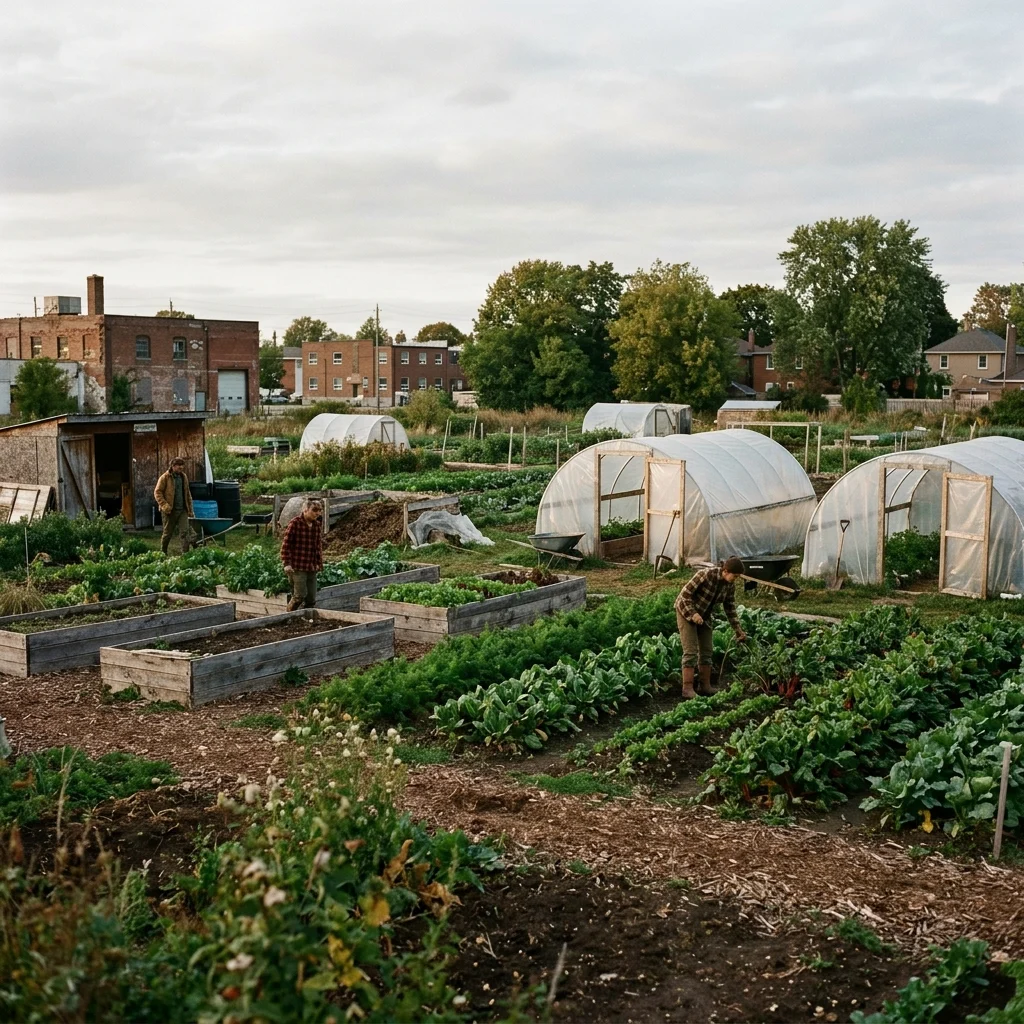
The first thing Urban Roots dispelled for Richie is the myth that nobody wants to do farm work. Applicants arrive the moment jobs are posted, young people return summer after summer, and some dream of their own operation. He notes that despite growing up in a rural community, no teacher ever suggested farming as a career — a gap that persists in cities too. The operation now runs just over an acre in year-round production, about 30,000 pounds of produce, and full-time labour supported by its own revenue model.
Richie is equally candid about urban farming's limits and the technologies pitched as food system saviors. He calls vertical farming what it is — vertical plant factory production — arguing it centralizes control with capital while growing lettuce that is 95 percent water and absent from UN hunger statistics. He extends the critique to precision ag, where equipment costs rise, farm data is owned and resold by manufacturers, and right to repair restrictions strip farmers of agency. Even urban farms carry real carbon footprints when they are temporary and displaced by development.
Listeners come away with a reframing of where renewal in Canadian agriculture might actually start: community-controlled land trusts, worker cooperatives, participatory culture, and education that builds systems literacy rather than just monetizable skills. Richie aligns with National Farmers Union policy, calls for local food infrastructure and for treating food production as an essential service rather than disposable widget-making. In a sector staring at demographic succession and wealth extraction, the unglamorous work of hands-on participation may matter more than the next shiny innovation.
Key themes
- urban agriculture
- farm succession
- food sovereignty
- vertical plant factories
- right to repair
- land trusts and cooperatives