
Decommodifying Land Through Cooperatives and Land Trusts Is the On-Ramp Agriculture Needs
The succession problem is usually described as a labour shortage; it is a property problem, and property can be reorganized without being handed over.
Published November 23, 2026
When Jesse Hirsh and Richard Scott Bloomfield circle the question of who will grow Canada's food, the conversation keeps returning to one blunt admission: the barrier is not appetite for the work. Urban Roots, the London, Ontario farm Bloomfield co-founded, has never struggled to fill positions. Applicants arrive the moment jobs open, and several return summer after summer, some of them openly dreaming of their own operation. The demand for a life in agriculture is present and measurable. What is absent is a way for people without inherited land to touch any.
That reframing matters because the Canadian conversation about farm succession has spent years describing itself as demographic. The average farmer is ageing out, the story goes, and young people are not interested. Bloomfield's on-the-ground evidence, and his research with first-generation farmers, complicates that story considerably. He notes that even in his own rural upbringing, not once in his public schooling was farming suggested to him as a career path. The pipeline problem is partly a cultural one of omission. But beneath it sits something harder: land and equipment capital costs so extreme that most first-generation farmers end up in small-scale vegetable production, Bloomfield observes, not necessarily because that is what they want to farm but because it is the only thing they can get their hands into. The crop choice is dictated by the asset they cannot acquire.
Land as the actual gate
This is where the title claim of the episode deserves to be taken literally. Decommodification — pulling land out of the speculative market and placing it under community control — is not a philosophical flourish in this conversation. It is a mechanism for the specific bottleneck that training alone cannot solve. Bloomfield describes cooperative and land trust models already operating at small scale: land held by a nonprofit with a board of directors, or by a worker cooperative, structured so that the asset cannot be flipped for financial gain. The point is to avoid the financialization and rising costs that have made entry nearly impossible without family wealth.
Hirsh's instinct is to press on the structural asymmetry: individuals cannot outbid the market, but cities have numbers, and numbers can pool capital and labour. Bloomfield agrees, carefully. He has worked the idea mostly in rural settings, where land trust and cooperative structures already exist, but the logic transfers. An urban constituency is, in fact, easier to mobilize. It is worth being precise about why this is the more promising direction. A land trust does not give a new farmer a cheap farm; it changes the terms on which the farm can be held, so that the price of entry is not the full speculative value of the asset. That is a different intervention than subsidies or training programs, both of which still leave the underlying property relation intact.
What an urban farm actually is
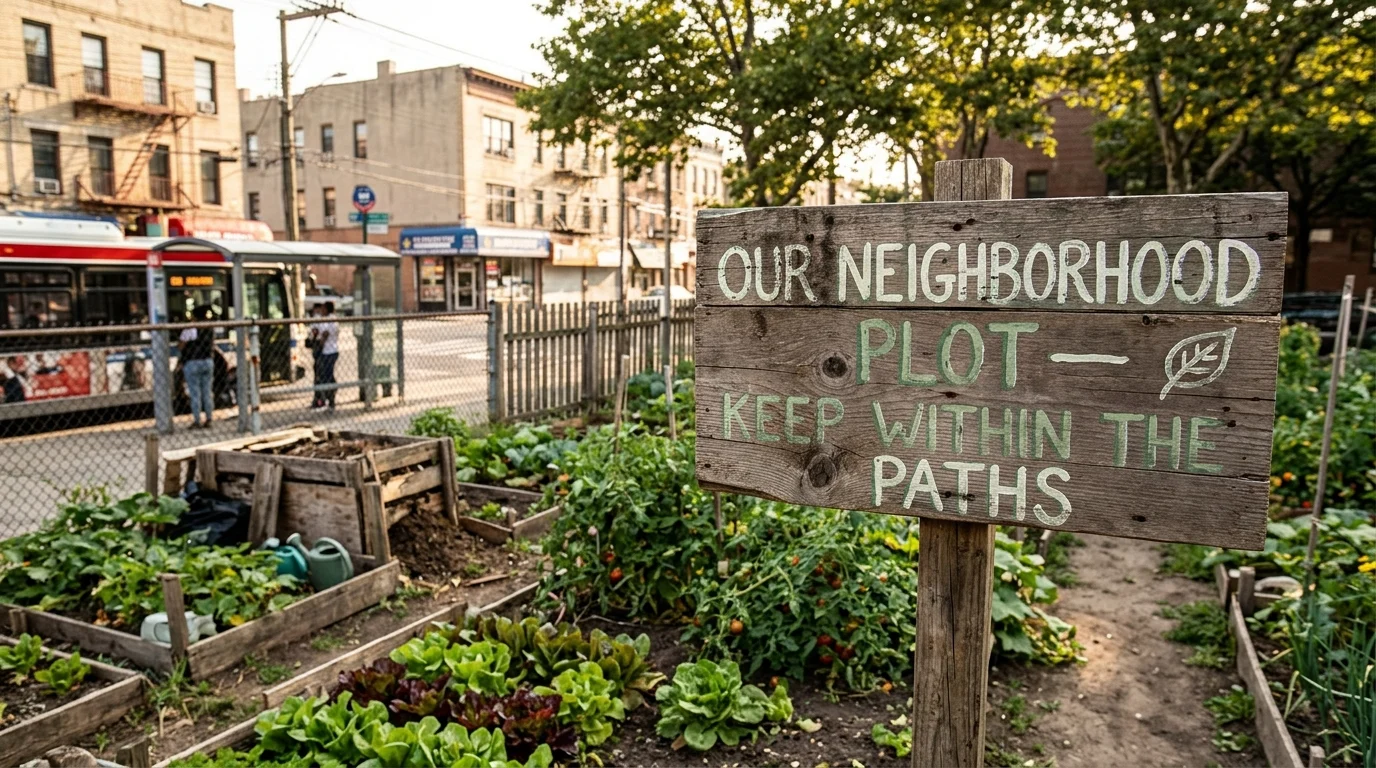
The evidence for demand comes from the shape of Urban Roots itself. What began with friends dragging a reluctant Bloomfield into an idea, modelled loosely on Detroit's urban farms on vacant land, has become roughly an acre in year-round production, 30,000 pounds of fresh produce annually, and full-time employment supported by the operation. Bloomfield is honest that this is functionally no different from a rural vegetable farm; the difference is access. People who live in the city can reach it by bus or bicycle. That single logistical fact is what makes it an on-ramp rather than an amenity.
But the design reflects a hard lesson about ownership and stability. Other urban farms Bloomfield's group learned from were dependent on municipal funding — able to give food away, and terrified of losing everything at the change of a political cycle. Urban Roots' "model of thirds," in which the operation generates part of its own operating revenue, is a partial answer to that fragility. The deeper stability question, which Bloomfield admits he does not fully have an answer to, is the five-to-ten-year enthusiasm window that policy grants to anything new. Land held in trust, by contrast, is not contingent on the next council's attention span. That is perhaps the strongest argument for the institutional form: it is durable in a way that program funding is not.
There are costs to acknowledging. Bloomfield refuses the rosy version of urban agriculture. Urban plots are temporary; development eventually displaces them, and the churn of temporary growing sites carries a carbon footprint that complicates the green narrative. He is equally careful not to castigate conventional farmers, most of whom are small operators doing the best they can within constraints, and he is sceptical of the binary that treats non-organic as moral failure. The point of structural reform is not to romanticize a practice. It is to make the practice sustainable as a livelihood.
From training ground to succession
This is where the argument closes its loop. If urban farms are training grounds — and the returning workers suggest they function as exactly that — then the rural communities that need successors require the second half of the infrastructure: models for reorganizing capital so that ageing landowners can realize value without simply selling to the highest bidder, and so that the people taking over can steward rather than squander the asset. Bloomfield's observation that first-generation farmers are trapped by capital costs lands here. Jesse's closing synthesis sharpens it: the succession problem is about property, and people who hold property understandably want their value preserved as they age. Decommodification is not about taking that value away; it is about structuring transfer so that the community and the land benefit too.
There is a plausible policy vacuum sitting right in the open. Idle land during ownership transitions, temporary access arranged through trusts or cooperatives, urban boundary farmland intentionally kept in production — Bloomfield's suggestion of a farmland perimeter inside a city's limits to both feed and train — these are pilot-scale, not utopian. They sit alongside the kind of structural thinking Bloomfield endorses from the National Farmers Union: right to repair, local processing and distribution capacity, and a food system oriented less exclusively toward commodity export. If food production is genuinely an essential service, as the pandemic language conceded, then treating it as one is a matter of institutional design, not sentiment.
The on-ramp already has traffic. People are waiting at the top of it, willing to do hard physical work for a livelihood they find meaningful. The task is not persuasion. It is giving the ramp somewhere to lead — which means the boring, difficult work of changing who holds the land, and on what terms.
Related Episode
Themes
- The Succession Crisis Is Really A Property Crisis
- Urban Farms As Training Grounds For Rural Successors
- Decommodifying Land To Escape Financialization
- Community Control As The Alternative To Municipal Whim
- Farmers Keeping The Margin In An Export-Oriented System